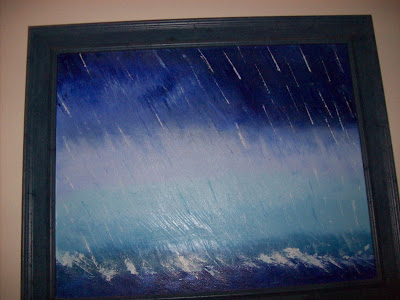
Most of the stuff I do are landscapes, painted from snapshots that I've taken various places. However, once in a while I just start painting and see what happens. This is one of those. It's called "Rain At Sea".
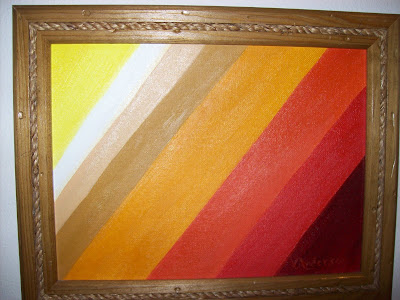
The next two are a set, done as sort of an experiment. Remember I said I couldn't draw a straight line? Well, I wanted to see if I could paint a straight line, which is actually rather difficult. Anyway, this pair are called, "Desert Day" and "Desert Night". The idea was to depict the passage of light though the day, beginning at dawn, into the white hot noon and the colors of late afternoon. Then, picking up where "Desert Day" stops, "Desert Night" depicts the colors of the night, passing from twilight, into midnight, dawn and early morning. These are both small paintings, about 9"x12", and hang in my hallway.

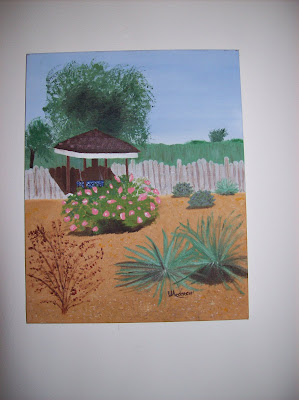
I don't think this is one of my better efforts but I keep it for sentimental reasons. It depicts my backyard when I lived in Marion, IL. The yard was landscaped with river rock pebbles and plants around a pool (not in the painting) and I had a platform built for my swing. The yard was finished just before my back surgery in 2000, and I sat in that swing for hours, enjoying the yard and the plants as I recovered from the surgery. Before I moved to Carbondale, I took snapshots of the yard so I could remember it.
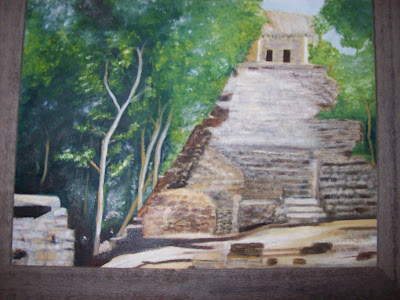 This was painted from a snapshot I took in Mexico on a trip touring ancient ruins.
 I've also done a few still lifes. This was painted from actual squash and apples posed against a cardboard background on a checkered tablecloth. I was never happy with the tablecloth, but finally said the hell with it.



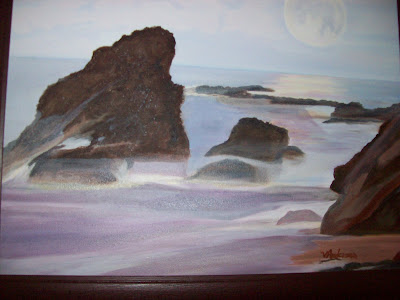 I rarely do a painting from another media of any kind, but this is an exception. My friend had an old calendar with a photograph of this beach scene from northern California on it. There was no attribution, so I don't know who the photographer was. Anyway, the scene intrigued me, and since I'm keeping the painting for personal use and not selling it, no sweat.


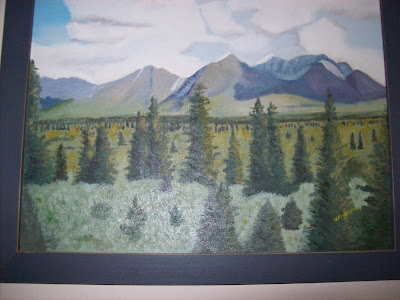
The painting above is one of my favorites. It's from a snapshot of a castle in Scotland, and I love the lush flowers with the shadowy castle in the background. (I was walking on the tan path shown in the painting when I snapped the photo.) This painting, along with "Tundra and Tiega" and "Rain at Sea" were the three paintings that were juried when I was accepted into the local Associated Artists Gallery several years ago.

This is another favorite. Not painted from another art media exactly, but "copied" nonetheless. I wanted a painting for my bedroom to match the sheets and pillowcases on my bed. I took a pillowcase, folded it in half twice, and used the image on top to paint this rather large canvas, which is indeed hanging in my bedroom. An interesting note is that in China I recently bought silk bed linens--and picked a pattern to match the painting!
The painting below requires some explanation. The church I belong to is part of the Unitarian Universalist Assocation. The UU symbol is a flaming chalice, often shown within two intertwined circles. The flaming chalice represents the spirit of our faith and the intertwining circles represent our heritage of Universalism and Unitarianism. There is a bit of a story behind this painting. In 2003, we were in the process of building a new church building. I got the idea to do a painting of a chalice and donate it to the church for the new building, which I did.

After the new building was completed, I waited to see where the painting would end up. After a year, I found it in a storeroom. This requires some additional explanation. At that time, the church had what was known as the "Arts and Aesthetics Committee", a group of women who basically evaluated items donated or purchased for the decor of the church and decided what would go where. (Can you see what's coming?) When I found the painting in the storeroom, initially I was furious and had my feelings way hurt! I took the painting home in a huff and hung it on my wall. In the coming months several other items donated by members got short shrift from the AAC, and tempers flared. Eventually the AAC was disbanded, and things settled down. There was some discussion about this issue, and the consensus was that the AAC had "new white tennis shoes syndrome". (You know, how when you have a brand new pair of white tennis shoes, you hate to do anything to get them dirty---but eventually they do get soiled and then it's OK if they get dirty and you have to wash them.) With a brand, spanking new church building, the AAC wanted to keep it pristine and dignified! Now this is a church of 200 members, many of them young families with kids, and there's no way a building can be used and stay pristine--and frankly, there is a difference between dignfied and prissy. In good condition and clean, yes, but not pristine--and definitely not prissy!
I'm quite certain I could take the painting back and someone would see that it was hung somewhere in the building. However, it was an early effort and I've decided it's not really that good. But I like keeping it on my wall. It keeps me humble.
So, for now, those are most of the paintings hanging around here. (As I'm typing this I realized I left out three small paintings of flowers. I'll snap them another time.) I'm planning another painting for my bedroom, perhaps from a snapshot taken in China. I'll try to be sure it doesn't clash with the sheets.


 Shortly before the guests were to arrive I removed the sheet from the table and poured ice water into the glasses. The little green and white striped boxes on the plates are cloisanne' bells from China, which I used as favors. The end plate doesn't have a box, since that's my seat, nearest the kitchen.


 This is adorable Phoebe, Carol's miniature horse. Carol says she has let her into the house, but she stayed outdoors while I was there. I've heard miniature horses are so smart they can be trained to be helper animals for the handicapped. And this one is very friendly as well.
 This will give you a better idea of just how tiny Phoebe really is! She was happy when I put grain into her feed dish. (I'm not much of a farm hand, having been a "town kid" all my life, but I braved the corral in order to get these pictures.)


 After that we went to the Tea Institute. Saw tea growing, how it is dried and served.
 Not only are the plants in the foreground tea bushes, but the plants on the hillside as far as you can see are also tea bushes.
 This man is hand drying tea for some of the more expensive types. All tea starts out from the same plant; differences in taste, aroma, etc. result from when the tea is picked and how it is dried and processed.
 The Chinese can be very whimsical. This ornamental pond at the Tea Institute has a "teapot" fountain.
 We were seated around a large table and given glasses with a pinch of tea. Then a woman came around pouring hot (not boiling) water into the glasses. Our tea guide explained that water for tea should never brought to a boil, as it "kills" the tea. The water is ready when little bubbles appear on the bottom of the heating vessel.
 Baskets of various types of tea were passed around and we were invited to smell the differences. There actually is a difference between the higher and lower grade teas.
 Peter, you're supposed to sniff it, not dive into the basket!
 A glass of tea made from a "magic" tea flower. Perfectly lovely and also very drinkable.
 The Ligong Pagoda at the entrance to the Lingyin Temple grounds was built in honor of the Indian monk who gave the nearby mountain its name. He thought it was the spitting image of a mountain in his home of India and he asked if the mountain had flown there. Hence the name of the hill, Feilai Feng ( the Peak that Flew Here).
 Lingyin Si (temple) is known not only for the large camphor wood Buddha, but also for the 470 Buddhist carvings lining the riverbanks and hillsides, dating from the 10th to 14th centuries.
 It would be interesting to know how the artists managed to carve these rocks without falling into the river.
 All the buildings are temples, active houses of worship, and photographs are not permitted inside. However it is acceptable to snap what you can from outside the door. Below is The Hall of the Four Guardians, containing four huge colorful figures, one of which you can see fairly well.

 Above is the Great Hall, which houses the 72-ft high camphor wood Buddha. This Buddha was sculpted from 24 blocks of wood in 1956, and is a replicable of a Tang dynasty original.
 Again, shooting from outside the door, I was able to get a pretty good picture of the huge Buddha. Many Chinese were buying incense and bowing and praying in all parts of the park area, but especially in front of this building and inside before the Buddha.
 Rainbow, our guide, told us she comes to Shanghai several times a year and the skyline changes with every visit. We saw cranes, steamshovels, and other evidence of construction on every hand. This city of 17 milion--17 million!--people, the largest city in China, is surging into the 21st century with a growth spurt that astounds even the locals. (But you still can't drink the tap water!)
 A local woman was selling postcards on the Bund. I bought a clutch of postcards and asked her to pose with me for a picture. She got the last laugh, though, because the postcards were at least several months old and do not feature the 101-story "can opener". By the time they come out with a set of postcards that do feature this unusual structure, other buildings will no doubt have risen to change the skyline once again. As Beijing went into a building frenzy leading up to the 2008 Olympiad, Shanghai is racing to complete shopping malls, hotels, and towering office buildings in preparation for hosting the 2010 Shanghai World Expo.
 If you turn away from the river and Pudong and look across the Bund, you see the hotels, banks, offices and clubs that flourished during the time Shanghai was colonized by the British, French, and Americans in the 19th and early 20th centuries. The contrast between the staid, older buildings and the gleaming towers across the river is fascinating.