The Cloud Pagoda, built in the 10th century, stands atop Tiger Hill. It is an octagonal, 7-story pagoda, which began tilting over 400 years ago, and currently is about 7 feet displaced from perpendicular at its highest point.
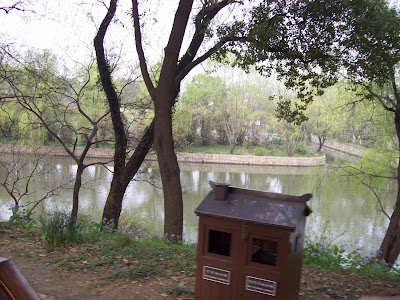
The park grounds are large and very beautiful with extensive gardens and some of the many canals that thread throughout Suzhou, which is known as "the Venice of the East".

 The largest Canal in China, the Grand Canal, lies just outside Suzchou, and is linked to the city's canals. The Grand Canal, begun in 486 BC, originally was meant to link the Yangzi and Yellow Rivers and the (then) southern and northern capital cities. It remains the world's largest man-made waterway, although the altered course of the Yellow River has reduced the Grand Canal's use for major transport. Its 1,112 miles do, however, link Beijing with the south all the way to Shaghai and Hangzhou.
The photo of the Cloud Pagoda above doesn't show it well, but there are over 300 steps leading to the base, for which Rainbow set off with some of the group. Several of us opted not to climb them, and Carol, Mike and I and Harry, a co-traveler from Bus 2, decided to take the horse and carriage ride that goes halfway around the park and back. We saw some lovely scenery along the way.
Took a horse and carriage ride with Carole and Mike rather than climb 330-plus steps! Blisters hurt like hell!


When we finished the carriage ride, Carol, who loves horses, had to have her picture taken with the horse. Some Chinese tourists had already boarded the carriage for the next ride. The horse remained calm while Carol was standing there, but as soon as she walked away, he began to buck and prance around, I'm sure giving the passengers a fright. I'm also sure the carriage driver, who took a while to get his horse back under control, was not happy with the "foreign devil" who spooked his horse!
I included the pictures below for several reasons. I like the red lanterns that lined the walkway, and also I have no idea where we were going when I took this picture--or the one below it. Possibly on the way to lunch???? The trouble with a trip like this is you go so many places so quickly and some resemble each other. You take a lot of pictures, thinking, "I'll remember this when I get home"--and you don't! I've got several more pictures like these, very nice, but no clue as to the subject matter! Next time I'm going to keep a picture notebook as well as a journal


The picture below is definitely a Suzhou canal. Many families live and work on the canals. Tourist boats ply the larger canals, and we were headed for one later in the day.

After Tiger Hill we went to a marketplace--crowded, noisy, colorful, disturbing.
We took a walk through a local marketplace, essentially a long street lined on both sides with vendors selling everything from clothes, fruits and vegetables, prepared foods, and foods "fresh on the hoof", so to speak. One of those was these eels below.

I took a couple of other pictures in the market but they were very blurry because I kept getting jostled. It was crowded and I didn't want to lose sight of the SB3 sign! Some of the sights in the market were disturbing to many of us. Live caged animals for sale is one thing. Geese flopping about on the pavement because their feet are wired together is something else. I had to keep reminding myself that I was the foreigner here and their ways are not our ways.

Here we are ready to board the boat for the canal ride. You can tell it's become dark, and you can also tell poor Rainbow is just about beat! Rainbow called this canal "The Baby Canal" to distinguish it from the Grand Canal.

It was pretty dark for a picture but you can tell how beautiful the canal is.
Then to dinner at a very nice restaurant and back to the hotel exhausted. Only here 1 night, so very little unpacking. Breakfast at 7 and on the bus at 8:15 headed today to Silk Factory and Hangzhou.
I'm going to stop again here, since it's taking about 3 hours per post. Will continue tomorrow.

 We did a drive by of the olympic stadium, (the "Bird's Nest"--and yes, it does somewhat resemble a bird's nest)) but the picture isn't very good, even after enhancing. It's set well back from the road, the picture was taken through the bus window, and there was quite a bit of haze in the early morning air. Beijing is noted for its serious air pollution problems, but most days it wasn't too bad. I had brought along a filtered mask just in case, but didn't need it.
 This lovely young Chinese woman showed us how the pearls are harvested from the fresh water oysters grown at the plant. She was typical of the local guides at the places we visited in that she spoke a precise English with a similar accent (were they all educated at the same school?) and was attractive and sophisticated. I expect these are plum jobs for young women in China.

 Quoting from "Eyewitness Travel, Beijing & Shanghai": " The sprawling grounds of the Summer Palace served the Qing dynasty as an imperial retreat from the stifling summer confines of the Forbidden City." The book goes on to describe how the grounds were remodeled several times through the centuries, most notably by the Empress Dowager Cixi (1835-1908), who is remembered as one of China's most powerful women.

 This is our Beijing tour guide, Anna, another lovely young Chinese girl, age 26. Because of the angle she's holding it, it's hard to see the "SB 3" sign. "SB" stands for "Santa Barbara", which was our designated group name for the trip. The entire group from California was divided into 3 buses, and ours, bus 3, was the smallest group at 21. Each bus had its own tour guides in both Beijing and Shanghai. These folks are very knowledgable about their areas and their English is excellent, if occasionally a little quirky.

 bought some odd foods on a stick. This is Peter eating deep fried scorpion. I kid you not! And he did actually eat some of it.


 This woman is carving a jade piece. The size of items ranged from tiny ornaments to huge sculptures. Jade is a semi-precious gemstone, revered in China for centuries. Originally used for tools in Neolithic times because of its hardness and strength, later jade appeared on ornaments and in funerary treasures. Pure white jade is the highest prized, but the stones vary in translucency and color, including many shades of green, brown, and black.
 This sculpture was in the lobby of the restaurant adjacent to the cloisonne' factory. Not a Buddha, but another revered Chinese figure whose name, sadly, I did not write down.
 This worker is soldering individual metal cloisons to enamelware. The lines of cloisons form separate designs which eventually will be inlaid with various colored enamels.
  This woman was our local guide in the cloisonne' factory. Here she's pointing out the details of a partially painted vase. The items are fired after each application of enamel, painted, fired, painted, fired, etc. then finally polished to a high gloss. Large items can take months from start to finish. Cloisonne' is one of several traditional Chinese arts.

 This sign in "Chinglish" attempts to explain something about Cloisonne' to English-speaking visitors. It is typical of signs we saw in other localities illustrating that literal translations are often just not possible.
 Group picture! This is one of several that were taken during our China trip. Most of the travelers were from Solvang, CA or nearby, but I was there from Illinois, Barbara from San Diego, and Bob and Mike from Malibu. I'm in the center in the red jacket. Carol is on my right and her brother Bob is on my left.
 Carol and I have been planning for months to "dance on The Great Wall". And here we are, along with Barbara! Notice who is out of step.
 A few sections of the thousands of miles of the Wall have been restored and are open to the public; however most of its length is in various stages of crumbling ruin and is too dangerous for visitors to climb. Originally a series of unconnected earthen ramparts built by local chieftains to protect their own states, the Great Wall was created only after the unification of China in the 3rd century BC. Watch towers were spaced two arrow shots apart to leave no part of the wall unprotected. The towers also served as signal towers, forts, living quarters, and storerooms for provisions. Many parts of the wall were reconstructed during the Ming dynasty (1468-1644). Those Mings were busy guys.


 It was a little difficult to eat and watch the performers at the same time, stopping often to applaud, but we managed.


 This is the Tian'an Men Gate, entrance to famed Tien'an Men Square, a huge open concrete space, familiar to most Westerners as the site of the bloody student protests in 1989. Chairman Mao's Mausoleum is a focal point within the square, and his portrait, also familiar to many Westerners, looms over the street opposite the gate.

 Mao's Mausoleum is the low building at left center. Our tour passed through the middle of the square from one end to the other, so we were not closer than this to the tomb. Visitors are permitted, but we didn't have enough time.
 Carving the Peking Duck. Yummy but very greasy!
 Me with the "Peking Duck" who stands outside the restaurant where we ate some of his family.